By Douglas Kidd
30th July 2026
This is an introduction to the medieval literary form of the bestiary and a critical consideration of the hierarchical assumptions that underpin it, suggesting that these continue to influence secular humanism and popular discourse in modern Western society. I argue for an Anarchist Bestiary: a bestiary reimagined to share stories that challenge those hierarchical assumptions and help us work together for a world in which all species thrive.
Open call: If you have an idea for this bestiary, please let us know, we will research your suggestions or publish your entry with due acknowledgements. The Anarchist Bestiary can be visited here, and the first few entries are available, along with a structure for your suggestions.
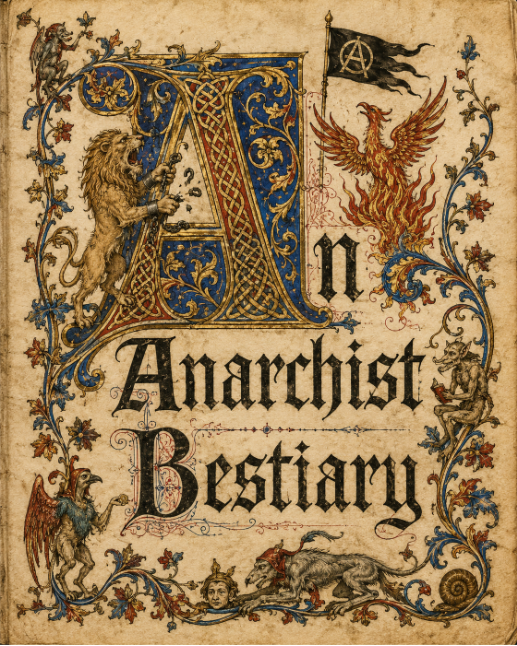
NOTE on the image: I used AI to create this frontpiece. Having looked more deeply at the environmental costs and the malfeasance of the corporations that dominate AI and whom I have supported in making this image it is something I will not be doing any more. In sharing this picture I direct you to the work of my partner Elke Van dermijnsbrugge- linked here, for more information on the true costs of AI.
The Medieval Bestiary
Bestiaries emerged as a literary form in the UK around 1200CE and were popular for the next 300 years or so. They were lavishly illuminated manuscripts that contained illustrations and information about animals and birds, insects, trees and even rocks, some real and some mythical. The illustrations would be accompanied by a story to inform the reader about the natural history of the beast concerned and a moral lesson that the reader could apply to their life. Various scribes and artists would have worked on each manuscript and their patrons were usually high ranking members of society or the church.
I will share a little of the history of bestiaries and offer a critical analysis of their influence, with a view ultimately to considering their potential relevance in the 21st century, and the possibilities for reimagining them for our current times.
Visiting with the beasts
Christianity animated the worldview of the bestiary and every entry reflected the rule and rules of God. In Christian tradition God discloses himself in two ‘books’- the bible which is the source of his revelation and law, and the natural world in which everything is a source for understanding God’s will and majesty. So the bestiary sought to reveal how the very nature and ordering of existence disclosed God’s will.
Let’s look at some examples.
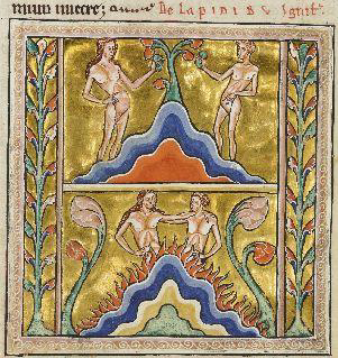
Fire stones are stones that can be female or male. Kept apart they are normal stones, but if brought together they ignite and burn everything around them. The moral is that men and women- especially in monastic orders- should be kept separate to prevent lustful thoughts and actions destroying everything.
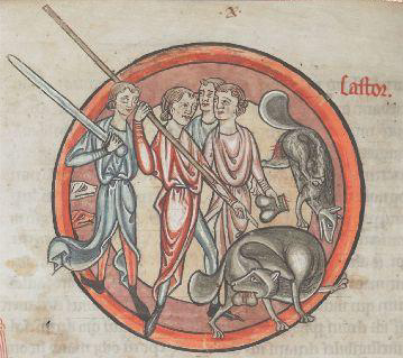
Beavers appear in bestiaries as animals hunted for their testicles which were a source of castoreum used to make medicine and perfume. When a beaver sees a hunter it will bite off its own testicles to leave them to the hunter. If the beaver is then unfortunate enough to encounter another hunter it will roll over to show that it has already lost its testicles so the hunter will not bother to capture it. The moral of the beaver’s testicular sacrifice is that Christians should cast off all vice and temptation to escape the devil’s traps.
Through the lens of Christianity, the natural world was a book of symbols read to discern God’s laws and purposes which must then be reflected in human society and behaviour.
The popularity of Bestiaries waned in the 1500s with a growing interest in scientific observation, empirical evidence and the study of the natural world for its own sake. New encyclopedias of animals were published based on scientific observations and experiments.
The effects of these shifts in thinking were felt throughout Western culture. There was no need for appeals to mysticism or religion, instead the scientific method, and human rationality were sufficient to determine truth, morality and the way to order civilisation, a philosophical approach referred to as secular humanism. Philosophers since the Enlightenment have pointed out the resonances, links and continuities between the Christian worldview and secular humanism, and I want to make the connections between mediaeval bestiaries and the way we view the natural world today. I want to suggest that two interlinked assumptions which underpinned the bestiary were carried through the scientific revolution into the secular humanist worldview and can still be discerned in Western scientific thinking and everyday discourse. Hierarchy is the key to these two assumptions.
The hierarchy of nature and natural hierarchies
The first assumption is that there is a separation between humans and the rest of the natural world. In the view of Christianity, God gave humans dominion over all the earth. The distinctiveness of humans in medieval thinking is revealed in the Great Chain of Being. This model of the universe had God at the top and the inanimate matter of Earth at the bottom. Humans are lower than the angels but higher, and so closer to God, than all other living things.
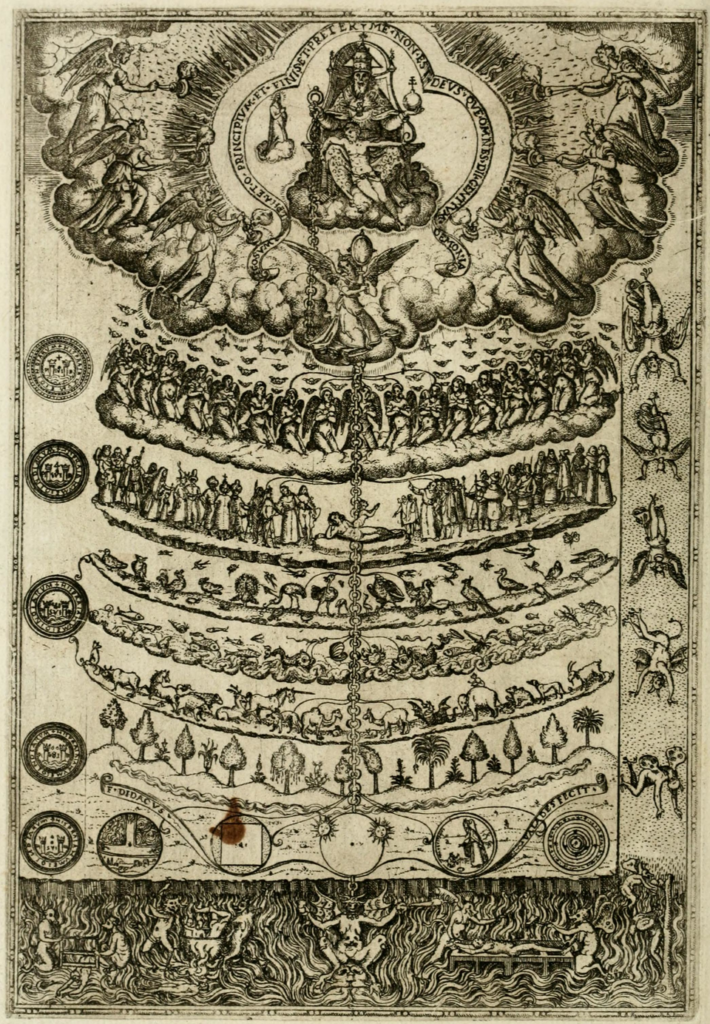
From Retorica Christiana, published by Diego Valdes (signed as F. Didacus in the bottom left) in 1579.
We can draw parallels between the Great Chain of Being and the modern theory of evolution. In scientific and everyday discourse, we continue to talk about higher and lower forms of life and see evolution as progressive and in some way destined to lead to modern self-conscious humans. Whilst many scientists and philosophers warn against this misunderstanding of the theory of evolution, it remains hard to avoid in popular discourse and in the language of much scientific literature, and far more consequentially it is embedded in the organisation of our modern world. The separation between humans and nature is also evident in everyday discourse, where we speak of nature as something to visit, or exploit or preserve, and the environment as a source of concern or political contention- in both cases as something separate to us where humans can take a ‘view from nowhere’, an objective view where we are not part of the rest of the world. Justifications base the distinct nature of humans on the complexity of human language and cognition, or the enhanced ability of humans to learn or develop complex societies or even by humans’ capacity for destruction. Practically, the dominance of the natural world by humans is evident. Of the biomass of mammals on earth, humans and their livestock now form 96%, with just just 4% of mammals being wildlife of the kind that formed many of the beasts in a bestiary.
The second assumption is that human society is hierarchical and in a way that mirrors the natural world. Humans appear together on the Great Chain of Being, above animals and below angels. But not all humans are equal, they have their own place on the Chain based on gender, race, birth, wealth and piety. Saints sit above sinners, men above women, priests and princes above peasants and paupers.
For secular humanism, evolution and progress replace God and the Great Chain of Being. The term Social Darwinism was coined to describe the link between modern scientific thinking in evolution and human social organisation. It involved applying evolutionary principles derived from Darwinian theory to society. For example, applying the simplification of evolution captured by the phrase “survival of the fittest”, socioeconomic status can be attributed to the fitness of those in each class. The poor must deserve their poverty due to their inferiority compared to the rich. The phrase “the White Man’s burden” refers to the idea that white Europeans had a duty to “civilise” less developed countries which must be populated by inferior races and which they could therefore justifiably colonise.
Oppressive structures based on race, gender, ability and colonialism have been morally justified by imagining modern society as the culmination of evolutionary competition in which the fittest survive and the strongest thrive. As the 20th century progressed, Evolutionary Psychology and Sociobiology made the links between the natural world and human society and they have been criticised on the same basis, for creating a sense that discriminatory social structures and discourses are natural and inevitable. These criticisms have come from within the scientific establishment and from philosophers, thinkers and activists increasingly concerned with our place in and relationship to the planet we all share, and I will present some of those criticisms now.
Undoing the hierarchical bestiary
Humans as distinct from nature
In the medieval bestiary, humans were considered unique divine creations, set above the rest of nature by God. For modern Western science, humans are unique and separate from the rest of the natural world in their capacity to study it from an objective ‘view from nowhere’, in the complexity of their cognition, language and societies, and in their capacity to impact the planet.
Philosopher Timothy Morton argues that the very concept of “Nature” is the biggest obstacle to our understanding of the world around us. It is a container for something ‘over there’, a place we can visit, protect, romanticise and exploit, but separate from us. Morton argues that we must drop the word nature if we want to understand ecology – indeed they titled one of their key works ‘Ecology without Nature’. Morton specifically argues against a hierarchical view of nature in which humans are able to look in from outside and objectively observe the world. Instead, Morton says, we are intimately and inseparably part of the world- there is no clear line as to where humans end and nature begins, as we are increasingly aware when looking, for example, at the bacteria that are integral to digestion in our guts or at our own impact on ecosystems.
Morton claims therefore we are forced to consider a new morality based on a new way of thinking where we stop seeing ourselves as separate from nature, exploiting it or trying to save it, but instead navigate the messy intimacies of our entanglement with the rest of the planet.
I think there are many who would resonate with the idea that humans are part of nature, yet the way our economies and societies are organised, and our language which describes nature as a resource to be exploited, implicate us in a view of the world which is still trapped in the bestial hierarchy.
Human hierarchies reinforced through nature
The medieval bestiary works as a self-fulfilling loop. Observe the natural world through the lens of Christian doctrine. Find explanations for those observations that fit the doctrine, then take those observations of evidence for the veracity of the doctrine.
Modern, Western science inherited this circular thinking replacing Christianity with evolution so that hierarchies based on race, gender, wealth for example, are assumed to be reflected in the natural world and to represent the end point of a natural and inevitable evolutionary progression.
To dismantle this assumption I refer particularly to the work of anarchist Pyotr Kropotkin, particularly his 1902 book, Mutual Aid: a factor of evolution, and then to feminist posthuman scholar Donna Haraway, particularly her 2016 book, Staying with the Trouble: Making kin in the Chthulucene.
Kropotkin criticised the way Social Darwinists used the idea of the survival of the fittest as a self-fulfilling thinking tool. Competition was considered as the key mechanism for evolution and so the nature and behaviour of every species was interpreted using this lens and thus seen then as evidence for it. Social Darwinists then drew an analogy between biological evolution and human cultural development which was interpreted as animated by an analogous mechanism of competition and survival of the fittest. When we use a phrase like: ‘it’s a dog eat dog world’, we are channeling this way of thinking.
Based on his own studies, Kropotkin countered that solidarity and mutual aid have a greater influence on both biological and cultural evolution than competition. He gave multiple examples from his own observations to support this contention such as the cooperative life of ants, or shared hunting techniques used by pelicans, writing:
Sociability is as much a law of nature as mutual struggle. Mutual aid is as much a law of animal life as mutual struggle. p. 5
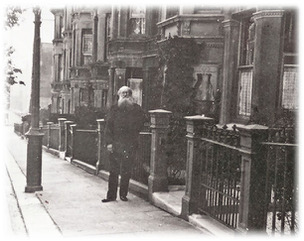
Kropotkin in Brighton c. 1911-17
If we accept his argument, then we also accept that hierarchy and oppression in human society is not inevitable, and is therefore within human control. He believed the analogy between biological evolution and human social history was untenable and served to justify social inequalities which had very real and traceable historical origins.
Kropotkin’s argument is therefore twofold- he is arguing against the simplification of evolutionary theory to the survival of the fittest and arguing against a simplistic translation of the mechanisms of biological evolution to human culture in which there are other historical, political and social factors in play.
Since Kropotkin’s time Sociobiology, Evolutionary Psychology and Human Behavioural Ecology have taken the place of Social Darwinism, still applying a similar lens to human society. Feminist and multispecies scholar Donna Haraway takes aim at these scientific approaches. For example, she criticises the way animal studies, particularly in primatology, are informed by the assumption that modern Western capitalism is the pinnacle of evolution and thus the exploitation, sexism, racism and inequality in our Western societies must be inevitable; a demonstration of the genetically strongest individuals making it to the top of society.
The vision of humans as the pinnacle of evolution and separate from the rest of the natural world is reinforced by an experimental approach to biology which builds on this assumption and then continues to find evidence of it. Haraway’s refrain is that it matters what stories tell stories. This means the following: if we begin with a story of hierarchy where male dominates female, then we will find evidence for that story when we investigate the natural world, and finally we will retell the same story about male domination being the natural and inevitable way of the world. Assumptions about gender identity are treated as biological imperatives and then encapsulated in the idea of genders as ‘natural’. Through this circular logic, scientific study has been used to ground and justify neoliberal morality, human exploitation of the natural world and patriarchal, heteronormative, colonial and racist structures.
Haraway points out the reductive and circular thinking going on here and points the way to a different kind of science that embraces a richer view of other species on our planet who can speak for themselves and offer their own insights.
Haraway argues for different stories, stories of interdependence and of relating across species that she calls “making kin”. When we come to a deeper appreciation and respect for those we share the earth with, celebrating our interdependence and finding ways to live together in which we all thrive, then we are making kin- developing kinship with the more than human world. These stories are increasingly being told by scientists and many others, but their impact on global, extractive capitalism is yet to be felt.
It is those kinds of stories that a reimagined bestiary can help spread.
An Anarchist Bestiary
The name Anarchist Bestiary was chosen because hierarchy is at the heart of the way of thinking that is challenged here. Dismantling systems of domination is at the heart of anarchism. This does not mean that every writer I have found helpful in thinking through this bestiary would accept the label anarchist, nor that every anarchist would accept the approach and ideas I am sharing. But as a title for a bestiary that eschews domination and hierarchy and shares stories of mutual aid, solidarity, creativity and kinship on a shared planet, anarchism can offer a valuable orientation.
The human and the more-than-human world are seamlessly interwoven with no hierarchy, says Morton. Mutual aid and mutual survival are at the heart of evolution, says Kropotkin.
Oppressive ideologies justified through circular analogies with the natural world must be uncovered and rejected, claims Haraway. The old bestiary was animated by hierarchy and domination. We need a bestiary that assumes interconnectedness and mutual thriving.
We can reimagine the bestiary in an anarchist context animated by no god and no master, but by practices for living together in a world where all can thrive.
In an Anarchist Bestiary our world is no longer seen as a hierarchy. Mutual aid and solidarity become fundamental principles with humanity deposed as the ‘arche’ that is the measure of all value, replaced instead by recognition and expression of our interdependence.
Imagine an ever growing zine which highlights new research, activist experiences, stories from the more than human world, collaborations and untold stories from marginalised voices and communities. Stories like that told by Katya Kyrlova in ‘The Beauty of Anarchy: Murmurations as a Collective Response to Uncertainty’ in Anarchist Studies journal issue 33 which has become the foundation for the first entry in Anarchist Bestiary.
An Anarchist Bestiary should be built from the bottom up with a clear intention: that humans and the more-than-human world find ways to build together and share futures in which all inhabitants of the planet can thrive.

Photograph by Graham Smith (available on unsplash).
References and Resources
- The Aberdeen Bestiary (The Bestiary at Aberdeen University is the source of illustrated examples shared in the piece): https://www.abdn.ac.uk/bestiary
- Haraway, D. J. (2016). Staying with the trouble: Making kin in the Chthulucene. Duke University Press.
- Kropotkin, P. (1902). Mutual aid: A factor of evolution. Heinemann.
- Krylova, K. (2025). The Beauty of Anarchy: Murmurations as a Collective Response to Uncertainty. Anarchist Studies, 33(2), 50–81. https://doi.org/10.3898/AS.33.2.02
- Morton, T. (2007). Ecology without nature: Rethinking environmental aesthetics. Harvard University Press.
The Anarchist Bestiary is hosted at https://punkethnography.org/an-anarchist-bestiary/