
By Ray Di Marco Campbell
27th March 2026
An Overview: Bigotry or Merely ‘Concerned “Mums and Grannies”’?
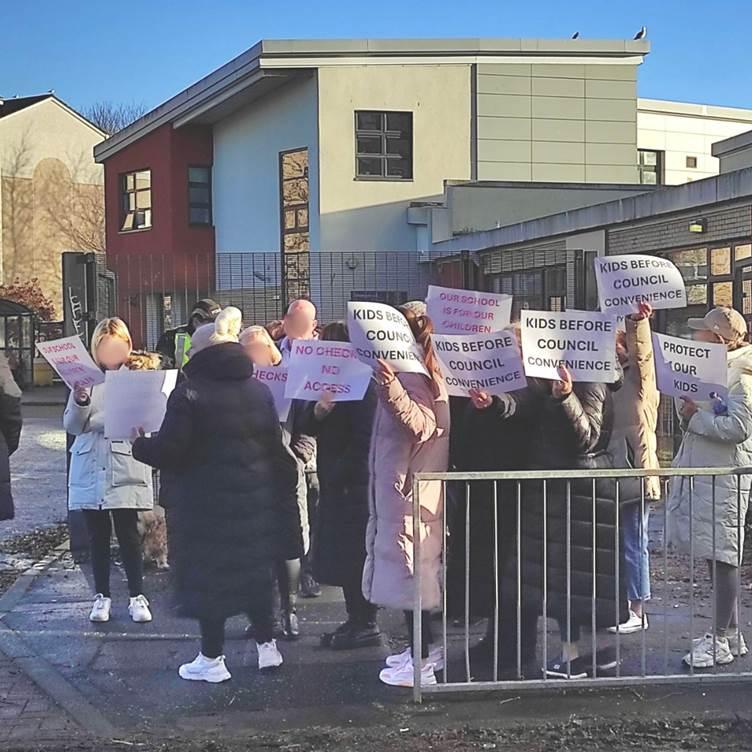
November 2025 birthed yet another racism-infused protest – around twenty ‘concerned’ adults gathered outside Dalmarnock Primary School in the east end of Glasgow to oppose adult ESOL classes being delivered in the community wing of the campus. I initially considered the whole affair too ridiculous to take seriously. Protesters carrying laminated signs demanded Glasgow City Council ‘protect our kids’ and sought ‘a group face-to-face meeting with education bosses after a protest over moves to hold English lessons for asylum seekers during class times’ (Keenan, 2025). Yet these classes were intended for a diverse range of learners, including ‘new migrants, asylum seekers and refugees, along with settled minority ethnic communities’ and, at the time of the protest, all four participants were mothers of students at the primary school.
State-backed adult learning of this sort is longstanding. Programmes such as those offered at Dalmarnock generally ‘aim to offer a range of non-formal courses to promote civic engagement and community development’ (Nicholson, 2024). Throughout Scotland, Adult ESOL classes support communication, engagement with children’s schooling, autonomy in daily life, and reduce isolation, while also improving access to rights, services, and employability (see e.g. Bariso, 2008; McIntyre, 2014; Tett and Maclachlan, 2007; Nicholson, 2024; Grayson, 2016; Rahbarikorroyeh, 2020; Scottish Government, 2022; Shiffman, 2018). Offering classes where adults already are reveals how often communities branded ‘hard to reach’ have in fact been merely ‘easy to ignore’ (Matthews et al., 2012). As Tett (2023, p.2) notes, community-based programmes are ‘most effective when practitioners build on their local knowledge of the community and specific groups’, provide accessible outreach, and link to other services. Operating from school campuses meets those criteria precisely.
Tett (2023, p.1) also stresses how vital such adult learning is in ‘reducing the attainment gap through supporting parents and their children in family learning programmes’. This is reflected in the rebranding of the Glasgow ESOL Forum to ESOL Scotland, intended to better highlight a national, diversified mission: creating ‘a future where every individual arriving in Scotland, seeking to learn English, finds an abundance of accessible, high-quality services ready to meet their needs’ (ESOL Scotland, 2025). Their ambitions state: ‘[n]othing about learners without learners’ and ‘[c]ultivat[ing] a culture of kindness’. Community-based ESOL classes for parents deliver exactly that. Firth (1998) further suggests that acquiring a language can give learners ‘the impression that they can “talk to the whole world”’, supporting the view that language is a means of agency and not merely the state purpose of assimilation. Still, such plainly beneficial outcomes are lost on bigoted protesters.
Grewar (2025) summarised the scene at Dalmarnock:
Arriving at quarter to nine on what appeared to be a normal Monday morning at the school gates, Calum saw little drama, despite reports of a planned morning picket. He was about to head on his way when he saw some women in puffer jackets holding a stack of laminated signs reading ‘kids before council convenience’ and ‘protect our kids’. Over the next hour, over 40 people gathered into two distinct groups. Directly outside the school gates were around 30 people, mainly women. On the other side of the street was a group of men dressed in dark clothing. The group of women were vocally hostile to reporters, shouting away a cameraman and vigorously challenging Calum about media ‘lies’. They described themselves as concerned ‘mums and grannies’.
These maternally-framed protesters claimed learners would be allowed on campus ‘unvetted’. In reality, the classes were not open to the public; they were for carers of children attending the school. Despite matter-of-fact statements by Glasgow City Council that the learners were already known to Dalmarnock Primary, those gathered still intimidated pupils, parents dropping off children, and the handful of parents hoping to attend class. Their presence fostered such toxicity that ‘[t]he school took the decision not to allow children outside during their break time’ (Elliards, 2025).
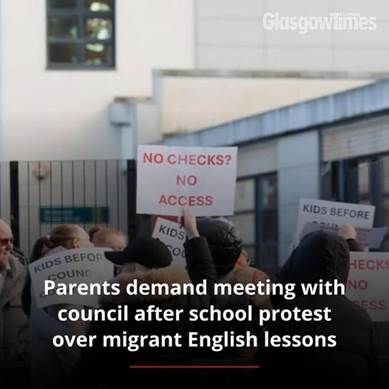
Reporting on the protestor numbers varies from 25-50 (Mearns, 2025; Grewar and Armstrong, 2025; Keenan, 2025). Some told reporters they had kept their own children off school that morning, yet appeared unconcerned about intimidating other primary-aged children. One parent said, ‘[t]his is causing stress and anxiety for families’ and wanted a council meeting ‘in a calm group setting’ (Keenan, 2025). Yet it was the protesters themselves who introduced fear, false allegations, and public hostility. Mechanisms already exist for parents to raise concerns. Direct action need not involve harassing vulnerable people.
These events mirror far-right demonstrations in Erskine during Spring 2023 by Patriotic Alternative. As Mackay (2023) argued, Conservative rhetoric around immigration had already created fertile conditions for far-right mobilisation in Scotland, and much the same discourse is now deployed by Labour (Nicholson, 2024; Chakelian, 2025; Lansley, 2025). Fascinatingly, the very same discourse around ‘unvetted’ men and endangered children was used to racialise asylum seekers and justify public agitation (by Patriotic Alternative, and later Homeland). Even where far-right links are exposed, they are not always removed from local influence. Mann (2023) flags the example of David Gardner who ‘remained an active member of both the [Forfar] community council and Homeland’ long after the revelations of his lead role were revealed.
So claims ‘that race was never a motive for their protest’ (Keenan, 2025) are not remotely convincing. Protesters revealed their xenophobic attitudes, telling Grewar (2025) they feared ‘the presence of foreign-born adults at the school’, as though the greatest risks to children do not overwhelmingly come from people already known to them (Lee et al., 2023; NSPCC, 2025; RAINN, 2025; Child Safeguarding Practice Review Panel, 2024). That reality did not stop outside agitators from appearing. Alex Cairnie, a self-described paedophile hunter from the Spartan Child Protection Team, with no connection to the school, attended and engaged in hostile arguments with journalists, denouncing the classes as ‘diabolical corruption’ (Grewar, 2025). Craig Houston, a podcaster facing criminal proceedings over racist conduct (Rodger and Shepherd, 2025), also turned up. Barold (2025) suggests that as much as ‘[h]alf the people at the protest don’t have children at the school.’
Fraser (2025, p.1) writes that ‘[a]nger and rage have become the dominant political emotions of our time’, and reactionaries have thus become something of a norm amidst movements seeking more socially just outcome. These white male protestors were, in that moment, the actual danger: unvetted, hostile, and lashing out when challenged. When Grewar (2025) asked one group of men why they thought the classes were being held at the primary school, they admitted they did not know, merely suspecting some unspecified ulterior motive. One protester complained, ‘[i]f they’re learning English, send them to the library’, neatly illustrating widespread ignorance about community development practice, educational access, and the hollowing-out of public infrastructure. Cairnie then escalated matters, proclaiming ‘sticking 20 to 30 adults in with children ain’t fucking right’. Barold (2025) reports the class involved only four caregivers.
Fraser (2025, p.5) warns that ‘[p]rolonged exposure to disinformation is radicalising significant sections of the population’. Yet there is also a broader and growing comfort with fascistic presences in public life. Members of Homeland and related far-right networks have already held local community council positions in Scotland (Mackay, 2023; Mann, 2025). (Homeland is a splinter group of Patriotic Alternative, with legacies of organising White Lives Matter demonstrations in Dundee and Ben Nevis on Indigenous People’s Day, membership to the British National Party, antisemitism, ‘plot to behead an MP’, ableism, forming extremist far-right splinter groups (e.g. Highland Division), holocaust denialism, and public records of race-baiting (Brady, 2022; Davis, 2023; Mackay, 2023)).
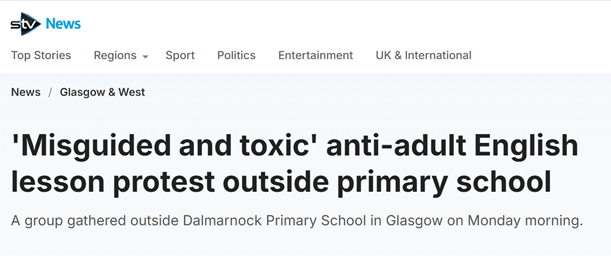
Against that backdrop, the state (in the form of Glasgow City Council) publicly described the protest as ‘misguided and toxic’ whilst proclaiming they will ‘not tolerate racism or bigotry of any kind in our schools’, making the motivations of the protesters even more transparent (Glasgow City Council, 2025). The same spokesperson added that ‘[o]ur schools are family education community hubs, and every parent and carer is welcome in their child’s school.’ That a previous family learning session had drawn no objection strongly suggests this was never about adults being near a school in general. It was about which adults. Stella and Kay’s (2023) studies of adult ESOL learners previously found that childcare responsibilities can delay integration and access to wider life in Scotland. On their own terms, then, these classes ought to ease anxieties – unless, of course, race and religion are in fact central to the objection (something parents protesting the primary school vigorously deny).
Even where protesters insisted they did not want to be associated with opportunistic outsiders (Keenan, 2025), the ‘concerned parent’ facade closely parallels the evangelical far-right or ‘patriotic’ nationalist movement campaigns that invoke child protection to target minorities and educational provision (Chakelian, 2025; Provost and Naira Archer, 2018; Perkins, 2023; Rosa and Naira Archer, 2019; Pearson, 2024). Public institutions often warp their practices to the demands of these pressure groups. Recent examples include attempts to remove books on gender identity from libraries and the redirection of police resources during far-right violence against asylum seekers in England (Keohan, 2025; BBC News, 2024). Coiffant-Gunn (2025) rightly warns:
The idea of politicians policing or banning books is profoundly troubling. It evokes images of authoritarian regimes, not a modern, democratic and diverse society like the UK. Even the perception that elected representatives can ignore established processes and policies to remove or relocate books based on their personal political views undermines public trust and risks serious harm, especially to those who are already marginalised.
Cowardice in the West Emboldens the Right
Whether or not we see these bodies as capable of taking the necessary action, state responses matter in dealing with public institutions and policy. Glasgow City Council backed existing practice and, in doing so, exposed the protests outside Dalmarnock as ridiculous and, frankly, racist. Yet barely a month earlier, Renfrewshire Council capitulated to similar protests at St. James’ Primary School, pausing adult education classes held in its community learning space. Those classes help learners become ‘able to speak confidently to the doctor or with a child’s teacher or to immigration lawyers’ (Henry, 2024, p.14). They reduce dependence on translation and other state-mediated support while expanding agency (see also Tett and Maclachlan, 2007; Rahbarikorroyeh, 2020; McIntyre, 2014). Renfrewshire Council’s subsequent public statement made clear that the model was ordinary and secure. Yet, rather than holding their group, the state has ceded ground to reactionaries and racists: ‘[t]o avoid any further disruption to the school, this group and similar groups’ use of the community learning facility is being paused and alternative locations will be found’ (Renfrewshire Council, 2025).
This is especially indefensible because community education routinely makes use of school campuses and other shared public facilities. Such arrangements are not some recent aberration. Schools have long functioned as community spaces, whether formally designated that way or simply compensating for the loss of other educational venues. Stewart (2025a) notes that ‘Glasgow’s education department [has] provided ESOL lessons for parents in primary and secondary schools for at least the past 20 years without parental concerns being raised’. For once, Glasgow City Council (2025) is to be commended for having a backbone – for now – in its hardline defence that ‘schools are family education community hubs, and every parent and carer is welcome in their child’s school’ (Glasgow City Council, 2025). Never forget though, that the state – whether local, regional, or national government – are the very bodies responsible for the many other harms caused by austerity, funding cuts, and co-option of once radical movements via partnership work (Nicholson, 2024; Tett, 2023). The state is not an ally, but, in this instance, one small part of it has stood up to bigotry and the far-right.
What this intervention demonstrates is Fraser’s (2025, p.1) broader argument that polarisation has ‘reduced the capacity of citizens to communicate rationally about contentious political issues through dialogue and deliberation’. But there is also a deeper problem: there are limits to what should even be opened to ‘debate’. As with attacks on transgender people, reproductive autonomy, or asylum rights, legitimising such hostility as a reasonable topic of public deliberation shifts the terrain rightward. Miller’s (2024) discursive approach becomes impossible when protesters refuse to recognise the humanity of the learners in question. As Grant (2023, p.1) argues, ‘good dialogue’ requires treating the other as a ‘fully equal human being’. That is not a practice enacted in these protests across Dundee, Falkirk, Glasgow, and beyond, nor is there evidence of compassionate prior action (Grayson, 2016).
Stewart (2025b) advises that ‘a recent surge in anti-immigration sentiment has prompted the city’s EAL [English as an Additional Language] support service to change its social media processes over fears it cannot keep learners safe’. As a Community Development educator and practitioner in Glasgow, I’m highly aware of other services – state or otherwise – which have had to hide many of their previously widely publicised resource maps as these supporting bodies have become targets for the far-right. And, yet, the 2024 rebrand of ESOL Scotland (2024, p.5) stresses the importance of accessible classes ‘scheduled at more widely convenient hours and levels’, precisely the kind of flexibility represented by school-based provision for parents with childcare responsibilities. These classes are not some reckless experiment. They are a practical response to barriers long documented in the literature (Cun et al., 2019; Bariso, 2008).
Indeed, Stewart (2025b) quotes a former ESOL tutor who had run classes in the same building years before and said she ‘never in a million years’ imagined emerging to find a protest outside. The novelty is not the provision. The anger is a sudden insert; these practices are not new. Elliards (2025) reports that one learner was even doxxed at the protest – named publicly, falsely accused of criminality, and identified by where she lived. These are not ‘strangers’ as claimed by protesters to Mackay (2023), rather these women are known members of the local community which, evidently, extends to a first names basis with those protesting against her on-campus education. Meanwhile, as Elliards further notes, some organisers themselves had no children at the school and had invited paedophile hunter Alex Cairnie and the right-wing podcaster Craig Houston to attend.
If the state representatives truly believe in access and opportunity, Glasgow City Council cannot capitulate if the threatened ongoing demonstrations continue. Protesters have already threatened ongoing disruption ‘every week for “as long as it takes”’ (Elliards, 2025). Meetings with school and council representatives have reportedly ended without resolution (Stewart, 2025a). Indeed, as the anti-migrant demonstrations in Falkirk and the rallies outside hotels across Scotland demonstrate, the notion that these hostilities would end if the parent learners attending ESOL on the community campus were simply to relocate is an outright falsehood.
ESOL as Empowerment, Agency, and Community
Students who have experienced racism need to know that all of their teachers are mindful and sympathetic. Language and power are inextricably linked, so it is important to acknowledge this and work to understand it.
McKinlay (2024)
I write this as a community worker, organiser, lecturer in community development, and parent of three young children. Glasgow City Council (2025) has been unequivocal: these ‘classes are for parents and carers of children at the school and nursery, “not strangers”’ and, because attendees are supervised, ‘“they do not need a PVG”’. For all my criticisms of the state, the council has on this occasion shown unusual backbone:
This campaign is misguided and toxic. We will also not tolerate strangers and vigilante groups coming into our schools claiming to keep children safe when they have a clear hidden agenda to incite fear and alarm by spreading misinformation and inciting violence which is bigotry fuelled and inflamed.
Set beside Renfrewshire Council’s cowardice, the contrast is stark. Renfrewshire clarified that those using the learning centre ‘would never have access to the primary school’, yet still moved the class ‘to avoid any further disruption’ (Grewar and Armstrong, 2025).
When I taught ESOL, classes took place across community centres, school campuses, colleges, and universities. That variation is ordinary. It reflects adaptation to context and learners’ needs. In one of the most innovative projects I have been involved with, a youth ESOL programme in Edinburgh used cooking facilities, sports halls, and computing labs on a community school campus to support language learning and social integration. In another, sports-based ESOL sessions required participants to respond quickly to verbal instructions, producing a very different challenge from a classroom lesson. Such experiences make plain that the setting matters, but only insofar as it serves access, safety, and participation. School-based ESOL for parents does exactly that.
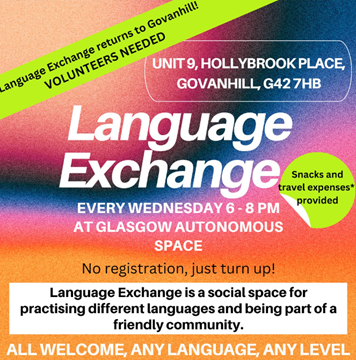
A related example sits tangentially within my local social centre: a language exchange initiative where English can be practised alongside Arabic, Farsi, Kurdish, Spanish, and others in an informal, mutual setting. The Glasgow Autonomous Space (‘GAS’) in Glasgow’s southside has operated now for close to a decade and, despite forced relocations, ‘provides a unique example of how organisations can utilise their cultural and resources to aid other bodies that share their values – e.g. by making their spaces ‘available for hire (for free or by donation) to groups and individuals organising for justice and against capitalism and its impacts’ (GAS, 2025a)’ (Di Marco Campbell, Forthcoming). Treating community as mutuality, GAS refrains from offering a programme of ‘provision’ in a statist sense, the centre hosts tens of organisations, coordinated via a council of representatives (the Group of Groups) which meets monthly to collectively manage the space. In something of a contrast to other autonomous spaces recognised by Kokova (2018) as ‘very leftist, very queer, very out there in every possible way’, the collective decision-making appears to operate more smoothly at GAS. Its existence reflects austerity-era cuts to formal ESOL and the long waiting lists many learners face.
Conclusions
As anarchist-informed as my politics are, I recognise that, at present, state-supported ESOL can make an incredible difference to people’s lives. Community-based programmes can help learners support one another, participate more fully in local life, and better engage with their children’s education. In Dalmarnock, the class was specifically oriented towards supporting intergenerational learning – both that of the parent and, by extension, their children.
Whilst not new provision and, no doubt, with ample room for adjustment, Stewart (2025a) notes that Glasgow’s education department has offered ESOL for parents in primary and secondary schools ‘for at least the past 20 years without parental concerns being raised’. That is to be commended – ESOL Scotland emphasises accessible provision with ‘classes scheduled at more widely convenient hours’ (ESOL Scotland, 2024, p.5). For once, Glasgow City Council deserves credit for showing backbone and defending the principle that ‘schools are family education community hubs, and every parent and carer is welcome in their child’s school’ (Glasgow City Council, 2025). Never forget though, that the state – whether local, regional, or national government – are the very bodies responsible for the many other harms caused by austerity, funding cuts, and co-option of once radical movements via partnership work (Nicholson, 2024; Tett, 2023). The state is not an ally, but, in this instance, one small part of it has stood up to bigotry and the far-right.
Rahbarikorroyeh (2020, p.3) has explained that existing ESOL provision in Scotland is less accessible to those with little prior formal education. Community-based alternatives are therefore urgent, not optional. That urgency is sharpened by Renfrewshire Council’s capitulation, which demonstrates that even where ‘Scotland’ as a whole imagines itself as standing against such bigotry, components within Scotland are willing to negotiate with its proponents.
Though it’s unlikely that Glasgow City Council’s hardline will herald the end of this facet of anti-migrant rhetoric, Renfrewshire Council caving in to bigotry has fuelled the racist fires – affording the protesters belief that they can change adult learning programmes. And, as Tett (2023, p.2) notes, once adults engage in learning, ‘their progression is often driven by the desire to continue to learn’. Hostility at the school gates, or relocation to less convenient spaces, risks interrupting that process entirely.
Drawing on anarchist literature, whilst recognising the many problems with English ‘as the most widespread colonial or hegemonic language’ and, therefore, frequently the sole medium through which communication must occur, Firth (1998) outlines the possibilities of social liberation through language acquisition: ‘power relationships within a system of quasi-communication — when the communication is through an interpreter — are also something of a problem from an anarchist perspective. Even while recognising English as a hegemonic colonial language, language acquisition still carries emancipatory possibilities. It enables people who would otherwise be excluded from collective life to participate more fully in it. Generally speaking, internationalists and anti-nationalists face the fundamental question of how to enable people of various languages, who are otherwise unable to communicate with each other, to enter unhindered collective activity’ (see also Stephenson Malott, 2012). As reluctant as the protesters at Dalmarnock Primary School clearly are for non-native English speakers to benefit from ESOL classes, the demands plastered across their placards and the misinformation relayed in their chants can only be understood fully – at least in terms of what is stated, if not the content – by other parents or staff who bear witness to the event and, ironically, not necessarily yet by the people they wish to deter from holding space on the community campus.
Relocating the adult learning classes has shown that parts of the state are ready to cede power to reactionaries; with the immediate consequence being precisely what Stella and Kay (2023, p.40) predicted – ‘further delay or interrupt access to ESOL learning’ as a result of ending convenience. Therefore, as Grewar and Armstrong (2025) remind us, whilst ‘[t]he Monday morning protest, which started as parents were dropping their children off for class, might be over – but don’t expect this to be the last of it’. With other state departments readily ceding space to bigotry, how long can any of us expect Glasgow City Council to hold its ground against a rising far-right? Thus, where Lorenz (2007) argues that radicals and, in this instance, frankly any non-bigoted liberals ‘must seek to support communities of color in building power against the racist state’, it becomes the duty of all involved in the schools affected and the wider community to reject the racist demands of those protesting families learning on campus.
References
BBC News. (2024). PM slams ‘far-right thuggery’ after hotel violence. BBC News. Available at: https://www.bbc.co.uk/news/articles/crg44dx9lz9o [Accessed on 5th January 2026]
Barold. (2025). Protest over free literacy program attended by asylum seekers sparks prejudiced fury. The Canary. Available at: https://www.thecanary.co/uk/analysis/2025/11/27/glasgow-school-protest/ [Accessed on 2nd December 2025]
Bariso, E. U. (2008) Factors affecting participation in adult education: a case study of participation in Hackney and Waltham Forest, London. Studies in the Education of Adults. Vol.40(1: Spring), pp.110-124
Brady, J. (2022) Outrage as ‘White Lives Matter’ banner draped over Dundee landmark. Daily Record. Available at:https://www.dailyrecord.co.uk/news/scottish-news/outrage-white-lives-matter-banner-27687551 [Accessed on 22nd December 2025]
Chakelian, A. (2025) Far-right protesters cower behind motherhood Lost men are using mothers to launder their dirty ideas. The New Statesman. Available at: https://www.newstatesman.com/politics/uk-politics/2025/09/far-right-protesters-cower-behind-motherhood# [Accessed on 8th December 2025]
Child Safeguarding Practice Review Panel. (2024) National review into child sexual abuse within the family environment. Available at: https://www.gov.uk/government/publications/national-review-into-child-sexual-abuse-within-the-family-environment [Accessed on 3rd December 2025]
Coiffant-Gunn, L. (2025) CILIP responds to Kent Library claims: “Libraries are trusted for providing facts and freedom”. Chartered Institute of Library and Information Professionals. Available at: https://www.cilip.org.uk/news/705344/CILIP-responds-to-Kent-Library-claims-Libraries-are-trusted-for-providing-facts-and-freedom-.htm [Accessed on 5th January 2026]
Cun, A., McVee, M. B., and Vasquez, C. (2019) ‘I Need Child Care!’: using funds of knowledge, addressing challenges, and developing literacies with a classroom community of adult ESL learners. Literacy research theory method and practice. Vol.68(1), pp.334-354
Davis, G. (2023) EXPOSED: The Sickening True Beliefs of Nazis behind the New “Homeland Party”. Hope Not Hate. Available at: https://hopenothate.org.uk/2023/05/07/exposed-the-sickening-true-beliefs-of-nazis-behind-the-new-homeland-party/?ref=theferret.scot [Accessed on 22nd December 2025]
Di Marco Campbell, R. (Forthcoming) ‘All Cocoons Are Temporary’: Reckoning with Instability, Breaking with Dichotomies, & Moving Beyond False Idols.
Elliards, X. (2025) Plan for weekly disruption at Glasgow primary school over English classes. The National. Available at: https://www.thenational.scot/news/25645691.protesters-pledge-weekly-disruption-dalmarnock-primary-school/?callback=in&code=ZJA3YMY1M2ITNME3NI0ZMZU5LWI4YMUTMZCYYTLMN2MYYTVH&state=25df7cf2306b4cc6ad6a9a82893a64ca [Accessed on 2nd December 2025]
ESOL Scotland. (2024b) Strategic Framework. Available at: https://esolscotland.co.uk/documents/esol-scotland-strategic-framework.pdf [Accessed on 8th December 2025]
ESOL Scotland. (2025) Strategy. Available at: http://esolscotland.co.uk [Accessed on 12th January 2026]
Firth, W. (1998) Esperanto and Anarchism. Available at: https://www.southchicagoabc.org/tal2025/en/w/wf/will-firth-esperanto-and-anarchism.a4.pdf[Accessed on 18th December 2026]
Fraser, G. (2025) Community Education, Populism and Deliberative Democracy. Concept: Journal of Contemporary Community Education Practice Theory. Vol.16(1), pp.1-14
GAS [Glasgow Autonomous Space]. (2025a) About GAS. In Di Marco Campbell, R. (Forthcoming) ‘All Cocoons Are Temporary’: Reckoning with Instability, Breaking with Dichotomies, & Moving Beyond False Idols.
Glasgow City Council. (2025) Dalmarnock Primary protest as parents gather over migrant lessons. Glasgow Times. Available at: https://www.glasgowtimes.co.uk/news/25645384.dalmarnock-primary-protest-parents-gather-migrant-lessons/ [Accessed on 30th November 2025]
Grayson, J. (2016) Solidarity Activism, Campaigning and Knowledge Production: Challenging Refugee Inc. The Case of G4S and Corporate Asylum Markets. Concept: Journal of Contemporary Community Education Practice Theory. Vol.7(2), pp.1-10
Grant, R. (2023) Men and Masculinity: A Philosophical Dialogue Approach. Concept: The Journal of Contemporary Community Education Practice Theory. Vol.14(3), pp.1-13.
Grewar, C., and Armstrong, R. (2025) School protests and anti-migrant paranoia in Dalmarnock. The Bell. Available at:https://www.glasgowbell.co.uk/dalmarnock-far-right-protests-migrants/ [Accessed on 1st December 2025]
Keenan, A. (2025) Dalmarnock Primary protest as parents gather over migrant lessons. Glasgow Times. Available at: https://www.glasgowtimes.co.uk/news/25645384.dalmarnock-primary-protest-parents-gather-migrant-lessons/ [Accessed on 29th November 2025]
Keohan, M. (2025). Backlash as Reform claims trans books removed from children’s library section. BBC News. Available at: https://www.bbc.co.uk/news/articles/c6257p2vry3o [Accessed on 5th January 2026]
Kokova, M. (2018). Adventures in Anarchist EFL. Available at: https://milenakokova.medium.com/adventures-in-anarchist-efl-4e94ad47337f [Accessed on 6th January 2026]
Lansley, S. (2025)Spring Statement: ‘Austerity is not the answer to Britain’s stagnant economy’. LabourList. Available at: https://labourlist.org/2025/03/spring-statement-austerity-britain-stagnant-economy/ [Accessed 28th December 2025]
Lee, J.Y., Yoon, S., Park, K., Radney, A., Shipe, S.L., and Pace, G.T. (2023) Father-Mother Co-Involvement in Child Maltreatment: Associations of Prior Perpetration, Parental Substance Use, Parental Medical Conditions, Inadequate Housing, and Intimate Partner Violence with Different Maltreatment Types. Children (Basel). Vol.10(4), pp.707-727
Lorenz, S. (2007) How are Schools Racist?: Let Me Count the Ways. Anarchist Library. Available at: https://theanarchistlibrary.org/library/steve-lorenz-how-are-schools-racist [Accessed on 29th December 2025
Mackay, N. (2023) How UK far right extremists have been shattered by Scottish rebellion. The Herald. Available at: https://www.heraldscotland.com/politics/23505742.uk-far-right-extremists-shattered-scottish-rebellion/?ref=theferret.scot [Accessed on 21st December 2025]
Mann, J. (2025) Far right Homeland activists gain Scottish community councils seats. The Ferret. Available at: https://www.theferret.scot/far-right-homeland-scottish-community-councils/#:~:text=“Simon%20Crane%20and%20Dave%20Gardner,respond%20to%20requests%20to%20comment [Accessed on 20th December 2025]
Matthews, P., Netto, G., and Besemer, K. (2012) ‘Hard-to-Reach’ or ‘Easy-to-Ignore’?: A rapid review of place-based policies and equality. Equality and Human Rights Commission
McIntyre, J. (2014) ‘Right, I can do this now’. Community Based Adult Learning, Health and Well-being. Concept: Journal of Contemporary Community Education Practice Theory. Vol.5(3), pp.1-9
McKinlay, M. (2024) How to support ESOL students in the classroom. The Education Hub. Available at: https://theeducationhub.org.nz/how-to-support-esol-students-in-the-classroom/ [Accessed on 4th December 2025]
Mearns, C. (2025) Parents gather outside Dalmarnock Primary school. In Glasgow City Council. (2025) Dalmarnock Primary protest as parents gather over migrant lessons. Glasgow Times. Available at: https://www.glasgowtimes.co.uk/news/25645384.dalmarnock-primary-protest-parents-gather-migrant-lessons/ [Accessed on 30th November 2025]
Miller, M. T. (2024) University Sponsored Adult Community Education: Exploring Motivations to Expand Diversity. Concept: The Journal of Contemporary Community Education Practice Theory. Vol.15(2), pp.1-13
Nicholson, G. (2024) Train Tracks and Tailored Learning: Is this the end of the line for government funded community education?. Concept: The Journal of Contemporary Community Education Practice Theory. Vol.15(1), pp.1-11
NSPCC. (2025) Child deaths due to abuse or neglect: statistics briefing. Available at: https://learning.nspcc.org.uk/research-resources/statistics-briefings/child-deaths-abuse-neglect# [Accessed on 11th December 2025]
Pearson, E. (2024) The hypermasculine far right: how white nationalists tell themselves they are ‘protecting’ women and children when they riot. The Conversation. Available at: https://theconversation.com/the-hypermasculine-far-right-how-white-nationalists-tell-themselves-they-are-protecting-women-and-children-when-they-riot-236250 [Accessed on 6th December 2025]
Perkins, T. (2023) US religious right at center of anti-LGBTQ+ message pushed around the world. The Guardian. Available at: https://www.theguardian.com/world/2023/jul/09/us-religious-right-lgbtq-global-culture-fronts [Accessed on 8th December 2025]
Provost, C., and Naira Archer, N. (2018) Christian Right and some UK feminists ‘unlikely allies’ against trans rights. Open Democracy. Available at: https://www.opendemocracy.net/en/5050/christian-right-feminists-uk-trans-rights/#:~:text=ADF%20International%2C%20the%20global%20branch,–%20such%20horror%20is%20incredible [Accessed on 8th December 2025]
RAINN. (2025) Facts & Statistics: The Scope of the Problem. Available at: https://rainn.org/get-informed/facts-statistics-the-scope-of-the-problem/ [Accessed on 3rd December 2025]
Rahbarikorroyeh, H. (2020) Lived experiences of ESOL provision: English learning by Syrian refugees in Aberdeenshire. Concept: Journal of Contemporary Community Education Practice Theory. Vol.11(2), pp.1-13
Rodger, H., and Shepherd, J. (2025) Podcaster charged after Glasgow southside councillor targeted with vile racist abuse. GlasgowLive. Available at: https://www.glasgowlive.co.uk/news/glasgow-news/podcaster-charged-after-glasgow-southside-31765520.amp [Accessed on 7th December 2025]
Rosa, S. K., and Naira Archer, N. (2019) UK Christian conservatives join ‘disastrous’ global backlash against sex education. Open Democracy. Available at: https://www.opendemocracy.net/en/5050/uk-christian-conservatives-join-disastrous-global-backlash-against-sex-education/ [Accessed on 7th December 2025]
Scottish Government. (2022) Adult Learning Strategy. In Tett, L. (2023) The benefits of community-based adult learning. Concept:,The Journal of Contemporary Community Education Practice and Theory. Vol.14(1), pp.1-10
Shiffman, C. D. (2018) Supporting Immigrant Families and Rural Schools: The Boundary-Spanning Possibilities of an Adult ESL Program. Educational Administration Quarterly. Vol.55(4), pp.537-570
Stella, F., and Kay, R. (2023) Language Learning and Migrant ‘Integration’ In Scotland: Exploring Infrastructure, Provision and Experiences. Project Report. University of Glasgow
Stephenson Malott, C. (2012) Anarcho-Feminist Psychology: Contributing to Postformal Criticality. In Haworth, R. H. (2012) Anarchist Pedagogies: Collective Actions, Theories, and Critical Reflections on Education. Oakland (California), U.S.: PM Press
Stewart, C. (2025a) Fears of more ‘toxic’ protests as council refuses to cancel English classes at Glasgow school. The Scotsman. Available at:https://www.scotsman.com/education/fears-of-further-protests-as-council-refuses-to-bend-to-pressure-to-cancel-english-classes-at-glasgow-school-5415366 [Accessed on 2nd December 2025]
Stewart, C. (2025b) ‘Our bilingual pupils are an asset for Glasgow’: Teachers hit back at Nigel Farage’s anti-immigrant comments. The Scotsman. Available at: https://www.scotsman.com/education/our-bilingual-pupils-are-an-asset-for-glasgow-teachers-hit-back-at-nigel-farages-anti-immigrant-comments-5432058 [Accessed on 8th December 2025]
Tett, L. (2023) The benefits of community-based adult learning. Concept: The Journal of Contemporary Community Education Practice and Theory. Vol.14(1), pp.1-10
Tett, L. and Maclachlan, K. (2007) Adult literacy and numeracy, social capital, learner identities and self-confidence. Studies in the Education of Adults. Vol.39(2), pp.150-167. In Tett, L. (2023) The benefits of community-based adult learning. Concept: The Journal of Contemporary Community Education Practice and Theory. Vol.14(1), pp.1-10