By Lejnad Hnát
29th April 2026
This essay is written at a specific moment in time, one in which the global anarchist scene is deeply divided, primarily due to differing positions regarding the invasion of Ukraine by the Russian Federation. These rifts did not emerge out of nowhere, as it might seem; rather, they represent a long-standing dispute within the movement that has now reached its peak in the current situation – whether through the silencing of selected Eastern European voices by denying them space at anarchist events in the West,[1] or through the selective choice of texts and information that confirm the group’s dogmas. The entire situation was aptly described recently by Nikita Ivansky, whose text was translated and published on the website of the Anarchist Federation:
“I still remember how, at one presentation, an anti-authoritarian activist from Ukraine spoke about Maidan and the situation after the protests, when a German expert responded that Kyiv had in fact simply been occupied by fascists. Attempts to show him that he was wrong were completely futile at that moment. Russian propaganda had already done its work on him. As I sat there listening to the presentation about Ukraine, it had not yet occurred to me that we had been incredibly naïve about our belief in critical thinking within anarchist and leftist circles.”[2]
A considerable number of texts addressing the issue of Russia and Ukraine from anarchist positions have already been written, as well as a plethora of polemical pieces in which authors attempt to argue with, or directly attack, the opposing side. Indeed, the Russian invasion also gave rise to a survey and a series of essays in which these ideas clashed.[3] There is no shortage either of subjective articles full of frustration and disgust caused by the condescending attitude of the Western left toward the Eastern one.[4]
What is entirely missing, in my view, is a deeper reflection on how the ignoring of Eastern European voices by parts of the leftist activist milieu actually comes about. I recently translated the aforementioned text by Nikita Ivansky. His text on dogmatism prompted a question in me: what is the state of the Czech antimilitarist scene, specifically the magazine Dezertér? This question led me to write the present text. I openly admit that it is written from within the anarchist movement; it is therefore not an academic or liberal lecture directed at activists. I believe that a simple answer invoking dogmatism is insufficient, and that it would be more appropriate to analyze the process and the power that lead to the ostracization of a part of the movement. Only then can we consider new strategies to replace the current ones, which are largely ineffective. In addition, I would like to follow in this text the issue of class and economic reductionism and their potential consequences.
As my source base, I will use a corpus of texts, articles, and posts published by the Czech antimilitarist magazine Dezertér, appearing both on its website and in the print periodical, as well as on its social media. I deliberately focus on the Czech anarchist context, as the corpus of original texts on this topic is relatively small and manageable. In my discursive analysis, I will draw on the ideas and concepts of the French post-structuralist philosopher Michel Foucault, whose analysis of power and the construction of identities appears highly suitable for my work. At the same time, I do not intend with this text to accuse the comrades from Dezertér or attribute malicious intentions to them; rather, it is a discursive analysis of a corpus of texts whose interpretation will help me trace the effects these texts may have and perhaps enable me to understand how the ostracization of one part of the radical left movement occurs.
I Am the Correct Anarchist – Who Is Moreso?
In the context of the antimilitarist magazine Dezertér, one tendency is particularly striking: the normative and authoritative construction of correct and incorrect identity. This position of correctness, associated with ordinariness, is present already in the thinking of the comrades themselves, especially in the following example, in which supporters describe themselves:
“Dezertér is the only true Czech anti-war magazine. We publish it independently, without support from the state, corporations, or political parties – solely thanks to the work of ordinary people, students, and workers who believe that rejecting war and militarism is more important today than ever before.”
However, this identity is not limited merely to self-description; it is present almost everywhere and spills over, for example, into constructions of correct and incorrect feminism, antimilitarism, anarchism, etc., with this “production” of correct and incorrect positions relying on effective word choice and framing:
“Feminism should support conscientious objectors and deserters … Feminism that takes its own principles seriously should stand alongside conscientious objectors and deserters … True feminism stands against war.”[5]
It does not stop at a merely prescriptive identity, but does not hesitate to use direct accusations against those deemed “incorrect”:
“Why are feminists who shout ‘my body, my choice’ silent when it comes to men who do not want to be soldiers, do not want to take up arms and fight?!”[6]
The production of opposing identities is even more apparent in the anarchist context:
“Therefore, it is necessary to build a strong international revolutionary workers’ movement, and anarchists, as antimilitarists, must stand in the front lines of this movement.”[7]
The text reveals a certain normative attribution of a quality whose absence implies incorrectness. This quality is further reinforced by an argument grounded in the historical continuity of the correct construction of the anarchist. One could say that a certain essentialization occurs, along with an impossibility of the development of anarchism as such:
“Anarchists have always been consistent antimilitarists who refused and continue to refuse to take part in wars of the powerful, ‘one state against another’; instead, they have always called and will continue to call upon their brothers and sisters across state borders to fraternize and not murder one another at the command of rulers and generals.”[8]
A similar confirmation of the “correct” identity can be traced in the following passage, which simultaneously defines itself against the “incorrect” position that does not adopt this strict and absolute antimilitarism:
“The anarchist movement has always stood in the front ranks of opponents of wars and militarism; it stood at the head of the antimilitarist movement. And it remains so to this day (despite a few confused individuals who failed to understand anarchist ideals).”[9]
This last excerpt reveals productive power in its full force (productive in the sense of creative, not repressive power). There is an attempt to normalize one identity – here, anarchism as absolute antimilitarism – while other anarchist identities are pathologized. A different perspective is not accepted; it is labeled undesirable. In the excerpt, a divergent opinion is considered confusion and a failure to understand “true” anarchist ideals, which leads to the construction of an incorrect identity. Implicitly, however, there remains a potential future possibility: to explain this “correct” ideal to confused people, thereby correcting them. For this reason, the pathologized Other is not understood as an equal discussion partner – their confusion and apostasy simply do not allow it and delegitimize any opinion. The Other is rather understood as an object of possible correction. Ignoring and not listening to these Others is directly desirable within this discourse, for how can one take seriously someone who has betrayed “correct” anarchism? In this way, the opposing side is discredited and a single authoritative interpretation of reality is established.
This can be summarized by a comment from Nikita Ivansky:
“At this point, I doubt that discussions or presentations can lead to a better understanding of what is happening between the ‘skeptics’ of the struggle against the ‘Russian world’.”[10]
Dialogue is simply not possible; the antimilitarist discourse – at least in the example of Dezertér – and its productive power do not consider this possibility from the outset. The core of the problem, in my view, does not lie in an unwillingness to listen, but in the fact that the structure itself significantly limits and prevents such listening.
The Regime of Truth
The above correlates with the concept of the so-called regime of truth. This refers to a set of rules through which power determines, within a society or community, what is true and what is not. Michel Foucault, drawing on Nietzsche, does not pursue truth in its ontological dimension but seeks to trace the historical event that led to the creation of the opposing categories of truth and untruth as tools of exclusion. Within these regimes of truth operates a so-called bearer of truth in the form of various institutions (governmental, scientific, ecclesiastical, etc.). Truth is thus not a neutral or independent category but depends on the power that produces it.
This leads to further questions related to power: who is considered a legitimate speaker and bearer of truth within the regime, and who should rather remain silent? What can be said within the regime of truth? And what will be labeled a lie?
In the previous chapter, I attempted to show how the antimilitarist discourse continually produces oppositional identities in its texts. The “correct” identity determines the legitimacy of the speaker, who is thus able to produce truth within this discourse. This manifests, for example, in the interviews published on the website – mostly featuring other absolutely antimilitarist groups or speakers. In one of them, exclusion occurs once again:
“But for us it is clear that once you (freely) put on an army uniform, you can no longer pretend to be an ‘anarchist.’ By pretending this, you are lying to others and also to yourself.”[11]
Here, the speaker is the bearer of truth, and anyone who considers themselves an anarchist yet takes up arms and a uniform is lying not only to others but to themselves. In other words, such people are labeled liars. Discursive power ostracizes on the basis of truth and untruth. The “correct” identity is thus linked to correct and true knowledge, and this identity is therefore granted a voice – once again strongly limiting dialogue, since within the regime of truth the subject does not wish to know a lie. The voice of the “liars” is therefore silenced.
For this reason, as already mentioned, the Dezertér website predominantly features interviews with other absolutely antimilitarist groups and individuals. However, they are not the only bearers of truth. There are also frequent testimonies of deserters and conscientious objectors; there is even a speech by a soldier who no longer wishes to fight and who criticizes the West and the USA for prolonging the war, etc., often without citing sources or verifying information. The source is not important, as the appropriate subject and content of the message produce truth within this discourse. In such cases, antifascists or antimilitarists who take up arms in order to preserve their own existence and that of their loved ones are demonized, discredited, and accused. Either they accept the “correct” identity and the associated regime of truth, or they cease to be relevant to the discourse – indeed, they cease to exist for it.
The regime of truth goes even further and determines what analysis of war and of global events is considered “correct.” Here I primarily mean the concept of class struggle, material relations, and violent revolution, which serve as the theoretical foundation of antimilitarist resistance, giving rise to the demand “no war but the class war.” The bearers of truth thus assume the role of always standing with ordinary workers, who should fight against their domestic state elites sending them to the front:
“For us as antimilitarists, it is not important which side we should support. Because we are clear: we stand neither on the side of Russia and China nor on the side of NATO (the EU and the USA). Our place is firmly alongside workers on both sides of the border – Russian and Ukrainian … As antimilitarists, we call on all workers at home and around the world: war is not in our interest! These are not our wars! And therefore let us not take part in them – and if we are forced to take up arms, let us turn them together against our tormentors: politicians and bosses! Drive them away from the troughs! End their rule and a new age will come: a world without wars, exploitation, injustice, and poverty.”[12]
This is highly problematic because reality is reduced solely to class struggle, and all political power is derived from economic power. This is certainly a legitimate approach, but it becomes problematic when it is the only approach. Such an analysis is unable to adequately deal with forms of power that are not governed by economic forces. Moreover, it assumes the working class as a homogeneous mass with identical and non-contradictory interests – defined solely by material relations:
“A worker in one country has nothing in common with the government that sends them to the slaughter. But they share a common fate with a worker in another country, against whom they are forced to fight.”[13]
It would be interesting to observe how the discourse would handle a scenario in which one segment of the working class exploits another, not on the basis of material relations or within the capitalist system, but on the basis of ideological conviction – for example, on the basis of gender, etc.
The above has far-reaching consequences and produces not only a legitimate voice, but also a legitimate victim and legitimate heroism:
“The true hero is the one who refuses war.”[14]
Other forms of heroism include imprisoned conscientious objectors and deserters, tortured conscripts at recruitment centers, and generally all workers and students exploited by the elite. This corresponds to one of the campaigns organized by Dezertér:
“Every year on November 11, poppies are worn on Veterans Day. A symbol of those who were sent to fight and die in the interests of the powerful. But the poppy reminds us of graves – it reminds us of death. We choose a different path. We do not celebrate wars. We celebrate those who refused them. Wars are not fought by presidents, generals, or arms dealers. Wars are fought by ordinary people, sent to kill and die for borders, profits, and power. But we have a choice. And some have already chosen: deserters, conscientious objectors, and those who said NO to orders. They are not traitors – they are defenders of life.”[15]
The category of life thus becomes what is valued within this discourse, while death is relegated to an undesirable position. An interesting example is the following excerpt, where two discourses, two regimes of truth, clash, each understanding heroism differently:
“European society is utterly sick. It is ruled by hatred and militarist madness. If you don’t believe me, it’s time for a little trip to Zlín. What if I told you that an exhibition of neo-Nazi mercenaries is currently taking place in Zlín? No, I am not making this up. From November 17 to 30, you can find ‘beautiful’ banners on Školní Street in central Zlín with the stories of four ‘valiant fighters from Ukraine.’ Fighters who illegally and entirely voluntarily joined the armed forces of a foreign state – forces that openly profess neo-Nazism and Bandera, with a long history of brutal war crimes.”[16]
Noteworthy here is not only the production of “madness,” “illness,” and “illegality” as tools of legitimacy and illegitimacy, but also the issue of celebrating people who voluntarily joined armed forces, whom the discourse attempts to discredit first by declaring their enlistment illegal and then through moral condemnation embedded in the label of neo-Nazism.
The narrowly defined “pure” identity continuously produced by discourse and the regime of truth thus generates selective solidarity. Paradoxically, within an environment that professes a non-hierarchical tradition – at least an anarchist one – it constructs a hierarchy of suffering and defines whose suffering may be mourned, who may be celebrated, and who must be condemned. It extends a helping hand only to selected people who correspond to the truth values of economic reductionism, which forms the firm core of this discourse. The suffering of others is either ignored or condemned.
The Narrative Construction of Truth
One more aspect present in the discourse must be emphasized – the Other appears constantly, implicitly and sometimes explicitly, in the texts. The definition of the “correct” antimilitarist is a negative definition of the militarist, and thus its regime of truth is merely a mirror inversion. As shown above, where militarism allegedly celebrates death, antimilitarism celebrates life; where militarism celebrates soldiers, antimilitarism celebrates deserters, etc. This mirroring is not limited to categories alone, but is reflected in the entire narrative.
Although Dezertér presents itself as a neutral party that supports neither the West nor Russia and advocates class war, its narrative frameworks resonate with Russian propaganda, thereby unconsciously positioning it closer to the side of the Russian Federation – even if it occasionally declares itself opposed to Russia and Russian imperialism. This may appear nonsensical at first glance, but when we consider that militarism in the texts is associated primarily with the West – according to Dezertér, European society is ruled by “hatred and militarist madness” – Russia then appears as a defender. Hence the strong focus on US and NATO imperialism, which in content outweighs the issue of Russian and Chinese imperialism:
“From the beginning, the USA and the EU were not primarily concerned with defending the Ukrainian people or ‘European values.’ The war was rather a welcome means of securing the economic dominance of Western powers, increasing profits for arms manufacturers and other companies, and an effort to weaken Russia through war, thereby preventing it from intervening in other conflicts around the world.”[17]
In this way, the war is presented as a proxy war, and Russia is depicted as a victim of Western imperialism. The regime of truth thus prioritizes information that criticizes the West more strongly. The relativization of who is the perpetrator and who the victim can be seen in the following example:
“An enemy in the form of ‘Russian evil’ was created, and against it a ‘fight for democracy’ was set. We ask: is this really the case? Is the war in Ukraine not caused by the rivalry between West and East for military, political, and economic hegemony over the world and global markets? Is the true culprit of the war really the one who fired the first shot, while being surrounded by NATO armies armed to the teeth? For us as antimilitarists, it is not important which side we should support. Because we are clear: we stand neither on the side of Russia and China nor on the side of NATO (the EU and the USA). Our place is firmly alongside workers on both sides of the border – Russian and Ukrainian.”[18]
In this discourse, the war in Ukraine is not only welcomed by Western powers, but actively instigated by them, which again corresponds to the needs of the regime of truth. This can be demonstrated by the text titled “NATO: Terrorists with the Mask of Heroes. Or How the War in Ukraine Really Began,” in which the discourse once again seeks to assign primary responsibility for events in Ukraine to the USA and the West, which allegedly overthrew the old government through a coup:
“And when the local working class fell into the hands of primarily Western oligarchs, the United States began eyeing Donetsk, where a NATO military base with missiles aimed at Moscow would ‘come in handy’ … However, then-president Viktor Yanukovych, although said to have been a corrupt bigwig himself, did not fully comply with American arms oligarchs. And so, in 2013-2014, the well-known Euromaidan occurred – a series of demonstrations in Ukraine’s capital Kyiv, culminating in gunfire from rooftops at demonstrators in the streets below. Responsibility for this massacre was attributed to Yanukovych’s government, although this theory was refuted even by Ina Kirch, director of the European Centre for a Modern Ukraine, who was active in Kyiv at the time. Based on existing evidence, she stated that protesters at Maidan were paid for their activities, as were those at ‘anti-Maidan’ demonstrations supporting Yanukovych. This was allegedly normal then (and still is) in corrupt Ukraine … An intercepted phone call between Victoria Nuland and Ambassador Pyatt also became public, confirming American involvement in the Maidan coup … The Donetsk and Luhansk regions did not recognize the unelected coup government of Poroshenko; separatists occupied police stations and administrative buildings and declared independence. And on April 15, 2014, the Ukrainian army, on the orders of the new prime minister Arseniy Yatsenyuk, launched a ‘special anti-terrorist operation’ – that is, it entered Donbas and began shooting at ordinary people. This, then, is the real beginning and the real culprit of the war in Ukraine.”
Further mentions again appear of neo-Nazis and the “sad” fact that the Czech Republic and other NATO states support the war in Ukraine.[19]
It thus appears that the antimilitarist discourse of Dezertér lacks any mechanisms that would protect it from Russian propaganda – indeed, more than that, Russian propaganda is used by it as argumentation for its own purposes, thereby helping to spread it. For example, the fourth issue of Dezertér featured an article in which a soldier spoke heartbreakingly, criticizing the West, Ukraine, and the USA. Although the magazine notes that “it is not confirmed whether the account is authentic or a stylized cry of despair – but regardless of origin, it strikes directly at the core,” this does not prevent the discourse from using the source to criticize the West and domestic political elites, which aligns with the antimilitarist regime of truth:
“And then comes the harshest criticism – not only of the West, but also of our own political elites. ‘We did not miss information about what our politicians are buying with financial aid. We did not miss how our compatriots enjoy decadent lives somewhere on beaches.’ A corrupt country where a university degree could be bought for a hundred dollars and votes in elections for even less. A country that, in war, sends generation after generation of young men to their deaths – completely senselessly, without a plan, without perspective. The diary ends with an appeal, a call, a desperate cry from the mud of the trenches. ‘It’s not worth it. Not another boy. Not another father. No kilogram of ore, no gram of lithium, no piece of land is worth it.’ Yet he remains at the front. Not because he believes in victory. But because he feels responsibility for those who should not be there. He is no longer a soldier; he is a protector of those whom the system has sacrificed. The name of this man remains unknown. But his words resonate far beyond the borders of Ukraine. His story is raw, authentic – and above all: desperately human.”
Whether fiction or not, this text serves within the discourse as a legitimate critique of the war and of the West and Ukrainian elites. It also provides claims that twenty-year-old boys are fighting at the front – which is not permitted under Ukrainian law – that there is no longer belief in defending Ukraine, that the dream of defending Ukraine with Western help has dissipated. Notably, however, there is again no criticism of Russia; everything is directed solely at the West and Ukraine itself.[20]
Russian propaganda most often targets the army and mobilization, seeking to discredit and demonize them,[21] which again aligns with the antimilitarist discourse of Dezertér. In the past, for example, short videos of crying Ukrainian soldiers under the age of twenty-five appeared, again criticizing the West and Ukraine for forcing them to fight – again without criticism of Russia. As later shown, the videos were created using artificial intelligence and were widely used by Russian propaganda.[22] That this is not an exception is suggested by another AI-generated video showing wounded Ukrainian soldiers marching as they evacuate from Pokrovsk. Another video showed Ukrainian soldiers surrendering to Russian forces.[23] It is characteristic that most of these disinformation videos spread primarily on Telegram and target cities in eastern Ukraine – areas the Russian Federation seeks to seize – thus attempting to provoke panic not only among troops but also among the civilian population.[24]
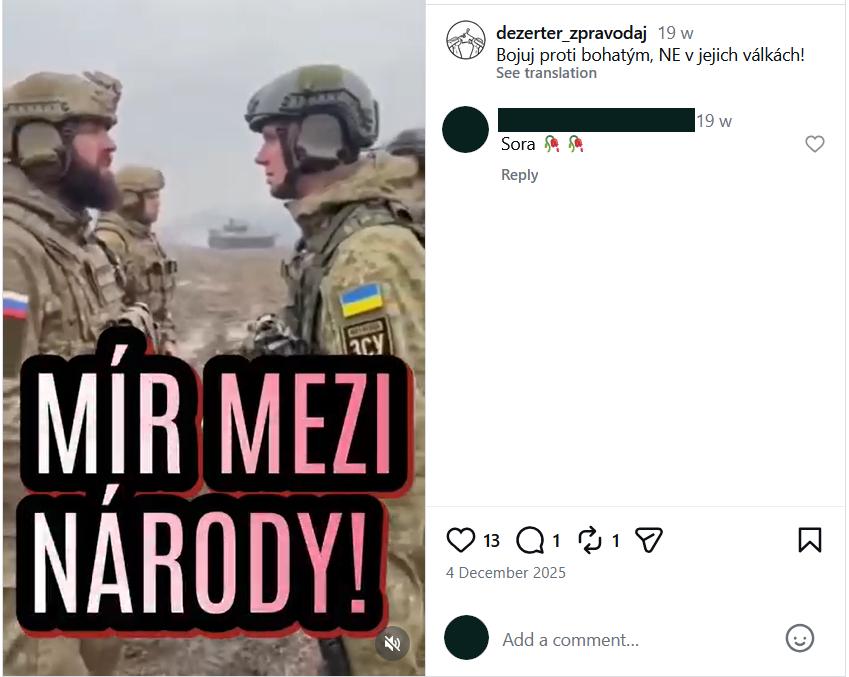
The antimilitarist discourse of Dezertér does not serve its purposes solely with unverified sources, but also with AI-generated videos themselves. One such video was published on Dezertér’s Facebook page, depicting soldiers from the Russian and Ukrainian sides shaking hands and then embracing, while the creators attempted to remove Sora’s moving watermark indicating that the video was artificially generated.
In this context, the antimilitarist discourse of Dezertér can thus become – albeit unintentionally – a tool of imperialism. This is enabled by the use of Russian propaganda aimed at delegitimizing the West, Ukraine, and the war, which the antimilitarist discourse of Dezertér uses for its own purposes. Russian propaganda, which deliberately delegitimizes the war, the Ukrainian army, and the West, thus represents fertile ground for the antimilitarist discourse of Dezertér.
Conclusion
In this polemical and analytical essay, I have attempted to show why efforts toward any dialogue or calls to listen to Eastern European voices on the part of antimilitarists were likely futile from the very beginning – at least regarding those voices that do not fit into the regime of truth of the antimilitarist discourse. Those who do not fit this regime of truth or are not considered legitimate speakers are automatically disqualified. Closing oneself within a narrowly defined subject that is deaf and blind to everything that does not correspond to its regime of truth leads the contemporary anarchist movement into chaos and weakens it – at a time when governments around the world are being taken over by populists with fascist tendencies.
Although the antimilitarist discourse of Dezertér presents itself as impartial and neutral, my interpretation suggests that it helps spread Russian propaganda. This need not be an intentional act by the magazine’s editors; rather – as I have tried to show – it is a matter of discourse and regime of truth, in which facts are less important than the legitimacy of the speaker capable of producing truth, and subsequently the content that fits into this regime of truth. This regime of truth lacks mechanisms to protect it from Russian propaganda. Moreover, Russian propaganda resonates with the antimilitarist regime of truth and is further used for its own argumentation and purposes, thereby helping to spread Russian propaganda within the leftist scene.
I remain convinced that we share much with anarchist absolute antimilitarism – whether criticism of all imperialism, the effort to create a stateless society, or the struggle against exploitation and belief in universal equality among all beings, even if our strategies differ. In my worldview, support for deserters can coexist alongside support for antifascists – not the state – who have decided to defend their loved ones and themselves; both levels are legitimate and anarchist to me. The very existence of these two distinct levels already fulfills anarchist ideals, which is why I find it problematic when one side seeks to authoritatively normalize the “correct” anarchist subject and exclude the “incorrect” one.
This is nothing new in the Czech context. Something similar occurred at the end of the 19th and the beginning of the 20th centuries, when, for example, the magazine Bezvládí defined itself against Nová Omladina and Práce, declaring that there were very few true anarchists in Bohemia.[25] This confirms the words of Saul Newman, who in his work From Bakunin to Lacan argued that:
“Essential identity, rather than being an identity of resistance, actually becomes an authoritarian signifier: it becomes a norm by which other identities are persecuted. It becomes the basis of a whole series of binary oppositions that restrict other identities by portraying them as a kind of failure or perversion of this norm.”[26]
Notes:
[1] ANTIJOB: Poslouchejte ukrajinské kamarádstvo. Available on: https://www.afed.cz/text/8587/poslouchejte-ukrajinske-kamaradstvo
[2] IVANSKY, Nikita: Antimilitarismus hlupáků. Available on: https://www.afed.cz/text/8605
[3] https://kontradikce.flu.cas.cz/en/online-content/156
[4] BROM, Zosia: Westplaining aneb reflexe se nekoná. Available on: https://www.afed.cz/text/8564/westplaining-aneb-reflexe-se-nekona
[5] Moje tělo, můj život i právo odmítnout válku. Available on: https://dezerter.noblogs.org/post/2025/10/09/moje-telo-muj-zivot-i-pravo-odmitnout-valku/
[6] Stop násilné mobilizaci na Ukrajině. Available on: https://dezerter.noblogs.org/post/2025/09/19/stop-nasilne-mobilizaci-na-ukrajine/
[7] Dezertér, issue 1, 2025, p. 4.
[8] Dezertér, issue 1, 2025, p. 4.
[9] Dezertér, issue 1, 2025, p. 3.
[10] IVANSKY, Nikita: Antimilitarismus hlupáků. Available on: https://www.afed.cz/text/8605
[11] Dezertér, issue 2, p. 15.
[12] Dezertér, issue 2, p. 11.
[13] Bojuj za svou pracující třídu. Ne v jejich válkách. Available on: https://dezerter.noblogs.org/post/2025/05/24/bojuj-za-svou-pracujici-tridu-ne-v-jejich-valkach/
[14] Proč jsme antimilitaristé. Available on: https://dezerter.noblogs.org/post/2025/05/10/proc-jsme-antimilitariste/
[15] Mezinárodní výzva. 11. Listopadu oslavme dezertéry místo válečných veteránů. Available on: https://dezerter.noblogs.org/nase-kampane/mezinarodni-vyzva-11-listopadu-oslavme-dezertery-misto-valecnych-veteranu/
[16] NICOL J.: Ve Zlíně se koná výstava neonacistických žoldáků z Ukrajiny. Available on: https://dezerter.noblogs.org/post/2025/11/21/ve-zline-se-kona-vystava-neonacistickych-zoldaku-z-ukrajiny/
[17] Imperialismus USA ukazuje svou pravou tvář. Available on: https://dezerter.noblogs.org/post/2025/03/02/imperialismus-usa-ukazuje-svou-pravou-tvar/
[18] Dezertér, issue 2, 2025, p. 11.
[19] NATO. Teroristé s maskou hrdinů. Available on: https://dezerter.noblogs.org/post/2025/04/01/nato-teroriste-s-maskou-hrdinu-aneb-jak-skutecne-vznikla-valka-na-ukrajine-nicol-j-dezerter-c-2/
[20] Dezertér, issue 4, p. 4.
[21] MYRONYSHENA, Tatyana: How Russia Weaponizes Mobilization fears in Ukraine. Available on: https://kyivindependent.com/how-russia-weaponizes-mobilization-fears-in-ukraine/
[22] https://www.youtube.com/shorts/U9_uje6Le4w ; https://www.youtube.com/watch?v=g5cmRmQvviI
[23] https://www.youtube.com/shorts/PtBoZhqmrfA
[24] VOROTYNSEVA, Maryna: Russia’s War in Ukraine: Russia’s Attempts to Undermine Mobilisation. Available on: https://icds.ee/en/russias-attempts-to-undermine-mobilisation/
[25] ŠTĚPÁN, Václav: Český anarchismus na přelomu století. Od devadesátých let 19. století do propuknutí Velké války. Praha 2023, s. 211–212.
[26] NEWMAN, Saul: From Bakunin to Lacan. Anti-authoritarianism and the Dislocation of Power. Available on: https://theanarchistlibrary.org/library/saul-newman-from-bakunin-to-lacan#toc7