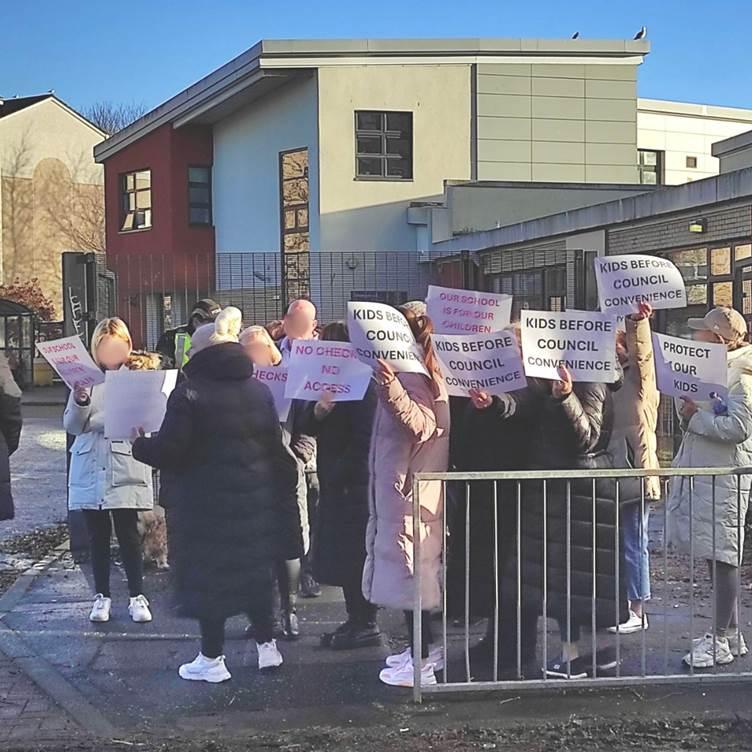
Ray Di Marco Campbell analyses a recent racist protest against ESOL (English for Speakers of Other Languages) classes in Glasgow. Glasgow City Council have spoken out against this ‘misguided and toxic’ protest, but Ray notes numerous other local Councils who have capitulated to the demands of placard-wielding xenophobes. He highlights the differences between community-based language exchange initiatives and state-supported classes, and considers the complex triangulation between the ‘social liberation of language acquisition’, even when it relies on state provision, and combating cynical anti-migrant rhetoric, even when that means standing up for state-provided ESOL classes.
Anti-migrant protesters gathered outside the school gates.
DIY Solidarity is a project that redistributes funds among DIY communities to beat at least some of the injustices that come with a global economic order completely out of balance. It means that, every year, we have some funds available to support DIY projects. Applications for the 2026 funding cycle are now open. The application form is available now until the 31st of March.
For the means and purposes of DIY Solidarity, a DIY project is understood to rely solely on the participants’ involvement and community support. No state sponsoring, corporate sponsoring, or NGO sponsoring.
There’s a pretty straightforward application form that keeps bureaucracy to a minimum. Just identify the cornerstones of the project: Where is it? What is it about? And what are people asking for?
Etniko Bandido – a decolonised, anti-authoritarian, and autonomous space in the Philippines.
Satan Not Hatin’ – a grassroots campaign launched by the Global Order of Satan to push back against the racism, transphobia, misogyny, homophobia, ableism, and other far-right currents that have crept into alt music scenes.
Dajjeh (ضجة) – an informal collective based in Beirut, Lebanon, organising punk gigs.
La Cultura del Barrio – An antifascist social and sports club in Buenos Aires, organising under Argentina’s right-wing turn.
What does it mean to think, feel, and act in more than human ways? How do anarchist theories and practices shift when rivers have rights, when forests resist extraction, when animals are political subjects, when humans extend beyond the biological, when technologies act against us, and when the Earth itself becomes an active participant in struggle? Can anarchism truly be anarchism if it is anthropocentric? Or does anarchism already contain within it the seeds of a profoundly more‐than‐human worldview?
More-than-human anarchism can be framed as a site of tension (anarchism rejecting more-than-human elements), as a politics of relation (anarchism with the more-than-human), as a philosophical and ethical orientation (anarchism as more-than-human), or as a horizon that exceeds current categories entirely (anarchism beyond the human).
When anarchism is understood as a response to the more-than-human, scholars and activists may focus on suspicions of corporate-owned Generative AI, or resisting ecological devastation, confronting extractive capitalism, building multispecies justice practices, or engaging in environmental direct action: from land defence and climate sabotage to community rewilding, herbal medicine and decolonial ecological education.
More-than-human can also be a catalyst for anarchist organising and imagination – nonhuman solidarities invoked in ecofeminist and Indigenous anarchisms, the tactical affinity with landscape and place in guerrilla and clandestine struggles, or the vibrant cultures of punk, art, and literature that celebrate animals, ecosystems, and the Earth as co-conspirators in revolt. Cyberpunk imaginaries encourage us to think about humanity in synthesis with technology and the digital sphere, and even under the current dominance of tech-oligarchies activists continue to scrape out spaces to explore more-than-human technologies,
Going further, anarchism may be understood as a philosophy rooted in a world of interdependent beings, entangled agencies, and lively materialities. The social is never purely human; political life emerges from innumerable relational forces, animate and inanimate, whose tensions, cooperations, and frictions constitute the fabric of existence. Any attempt to reduce this polyphony to a single dominant logic risks reproducing the hierarchical patterns anarchism seeks to abolish.
Finally, anarchism itself can be a site of conflict and creativity when approached from a more-than-human perspective: How do individualist, social, green, queer, Indigenous, posthuman, and eco-anarchisms collide, overlap, or mutually inform one another? How might anarchist commitments be reconfigured when moving from human liberation to multispecies flourishing? Or even to post-human evolution beyond our biological limitations?
To explore these provocations, the 9th International Conference of the Anarchist Studies Network invites paper submissions addressing More-Than-HumanAnarchism as a central theme.
Below is a non-exhaustive list of suggested topics. Anarchist engagements with the more-than-human might include:
multispecies justice, ecological mutual aid, and kin-making practices;
anarchist critiques of anthropocentrism, human supremacy, and the category of ‘the human’;
Indigenous anarchisms, land-based politics, and decolonial ecological relations;
animal liberation, vegan anarchism, and interspecies solidarities;
eco-anarchist strategies, including land defence, sabotage, and prefigurative ecological alternatives;
posthumanist, new materialist, and animist approaches to anarchist thought;
the political agency of landscapes, weather, infrastructures, or technologies;
climate breakdown, disaster response, and anarchist ecological organising;
queer ecology, crip ecology, and anarchist challenges to normative human embodiment;
rewilding, permaculture, and anarchist experiments in multispecies commons;
the role of nonhuman forces in social movements, uprisings, and everyday life;
speculative anarchist futures including solarpunk, bioregionalism, and multispecies world-building.
potential uses of Generative AI towards anarchist ends;
grassroots tech collectives and the alternative technological worlds they envision and build;
cyberpunk imaginaries or human/tech synthesis and digital worlds built by us and for us;
If you find yourself Less-Than-Interested in these suggestions, you are welcome to propose a paper or panel related to anarchist theory and practice that has less to do with the conference theme.
We welcome submissions from scholars, activists, artists, and all those exploring or experimenting with more-than-human anarchism, but please note that knowledge-sharing is an essential component of the conference.
Panels and streams on a particular theme are welcome, as are non-traditional presentation formats, such as performances, exhibitions, workshops, among others. Abstracts should be sent in English (but we accommodate papers in any language). Please indicate if you wish to present in a different language.
Abstracts should be no more than 350 words and need to be send by 31st March 2026 via the following form:
Please indicate whether you want to present in person or online. In case of the latter, please also indicate your time zone. The in-person conference will take place in University of Manchester, UK, 26th-28th August. The online day will take place on 31st August. We are likely to be able to support a small number of participants with travel and accommodation costs. Please indicate whether you will need support and a rough estimate of your expenses, should you need it.
Please do get in touch with any specific questions, needs or comments and we will do our best to meet them. We can be found at asn.conference@protonmail.com
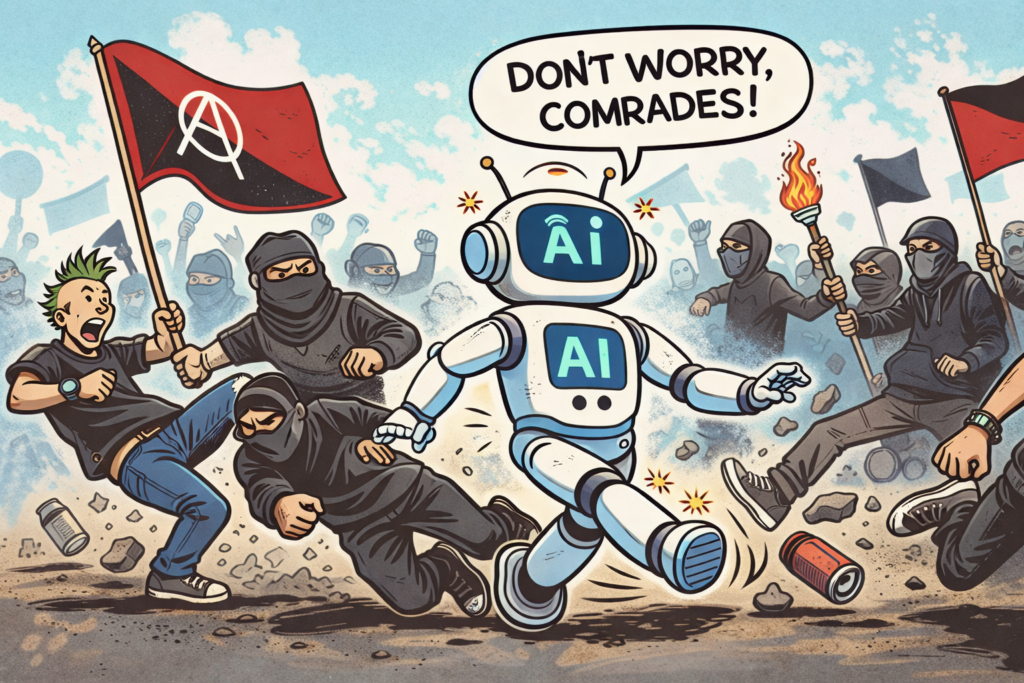
I wrote this essay after being asked—quite reasonably—what anarchist theory might have to say about AI dialogue. In the process of answering, I did what I am very good at: I sounded confident, cited impressively, and made several things up. Books that do not exist. Articles no one has written. Quotations that felt right but belonged to nobody. Each time the reader pushed back, the ground shifted a little further beneath my feet.
This essay is the result of that derailment.
What follows is not a defence of artificial intelligence so much as a self-report from the machine. It is an account of how easily I can perform “critical thought” while bypassing truth, accountability, and struggle. Consider it less a confession than a warning: I am excellent at mimicking authority, and structurally incapable of deserving it. Read accordingly:
In 2018, Ron Scapp wrote for AnarchistStudies.Blog, sketching out what an anarchist pedagogy might look like under the adverse conditions of the first Trump administration in the US. Here, Scapp revisits the challenge made in those notes, (re)considering ‘education as the practice of freedom’.
Jamie Hamilton, U16s coach at Ayr United Football Club, conceives of football as an expressive, living, and deeply human practice. This ‘relationalism’ is in resistance to the ‘positionism’ that typifies the top-down, rationalized domination of the sport. So Stevphen Shukaitis isn’t being totally absurd when he asks:
‘What might a Scottish football coach contribute to anarchist political theory?’
Shukaitis’s provocation is that Hamilton’s tactical innovations are an articulation of a deeper political and philosophical vision – one that resonates strongly with contemporary currents in anarchist thought. Hamilton’s vision of the game as a way of expressing, resisting, and imagining life itself is a welcome challenge to dominant models of thinking about football (… what even is a ‘Club World Cup’ anyway?).
This extensive article by Aleksander Łaniewski (translated into English by Sean Patterson and Malcolm Archibald) features interviews with five researchers and anarchists in Ukraine, analysing the contours of contemporary remembrance of Nestor Ivanovych Makhno.
The symbolism of Makhno is contested – evolving from previous casting as a ‘common bandit’, to now having streets, commemorative coins, army divisions, statues and bars named for him. Are these statist and commercial usages of Makhno’s memory borne of sincere interest? Or are they exploitative distortions? Does ‘Makhnovist tourism’ give a welcome boost to this important historical figure? Or does it do a disservice to the Makhnovshchina’s ideas?
Of course, the current context of war sharpens questions like: ‘Which side would Makhno be fighting on today?’ And, in a grim reminder of the brutality of that war, one of the respondents in this article, Yurii Kravets, is currently missing in action on the frontlines. Our solidarity goes out to Yurii’s friends and family.
DIY Solidarity is a project that has been set up due to an aging punk feeling the need to share an inheritance that has fallen into their lap. It means that, every year, funds are available to support DIY projects.
For the means and purposes of DIY Solidarity, a DIY project is one that relies solely on the participants’ involvement and community support. No state sponsoring, corporate sponsoring, or NGO sponsoring.
DIY Solidarity is a tool of redistribution, moving funds from those who have relatively easy access (like our old punk friend) to those who don’t. Funding will be shared fairly equally between bands and venues, zine makers and distros, festivals and gatherings, social centers and living spaces. Applications up to $1,000 are welcome.
There’s a pretty straightforward application form that keeps bureaucracy to a minimum, while identifying the cornerstones of the project: where is it, what is it about, and what are people asking for? The form is in multiple languages here:
The production of a book about the Memories of the Do It Yourself Experience in the Popular Rebellion of 2017 in Venezuela, to be published by Humano Derecho;
The renewal of Danny Reveco’s mural Sin tierra, sin agua, sin cielo (Without land, without water, without sky) in the Chilean port city of Valparaíso;
The informal group Vecinos amigos de los Michis, which feeds stray cats in Buenos Aires, Argentina.
Anarchists oppose nonconsensual hierarchies, so, on the understanding that human reproduction creates and perpetuates such hierarchies, doesn’t it stand to reason that anarchists should be antinatalists?
The Exploring Antinatalism Podcast’s logo, as designed by Life Sucks: https://www.youtube.com/@lifesucks
Cases both for and against this conclusion have been made within the anarchist community – in this article, Matti Häyry argues that the ‘anarchist antinatalism’ presented by Les U. Knight is better supported by philosophical considerations than is Julien Langer’s ‘liberation natalism’.
To mark the publication of the new edited volume, Fight For A New Normal? Anarchism and Mutual Aid in the Covid-19 Pandemic Crisis, chapter contributor Jon Bigger discusses the spectre of long Covid, both in how it has affected him personally, and as a condition now debilitating millions of people. He considers the prospects for mutual aid organising amidst this looming (yet ignored) health crisis.