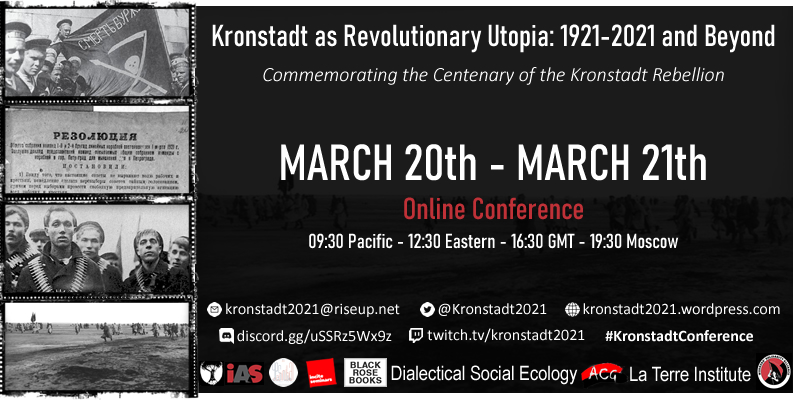
Marx rejected the ‘syndicalist path’ in his quarrels with Bakunin during the years of the First International. But, in this article, Mustapha Mond asks whether syndicalism might in fact represent the very essence of Marxian socialism, as a model of ‘the self-government of the commune’ and as a bulwark against despotic ‘red bureaucracy’.
‘Survival is an act of resistance’ – an interview with Kes Otter Lieffe
Kes Otter Lieffe is a working class, chronically ill, femme, trans woman, and author of a recent trilogy of sci-fi novels that are rich with trans, queer, anarchist, and dystopian themes. In this interview with Jim Donaghey she discusses how the books reflect her own life experiences and identity, the eerie speculative prescience of their near-future crises, and the ways in which these fictional communities echo the dynamics of real world social movements.
‘Survival is an act of resistance’ – an interview with Kes Otter Lieffe
Contemporary Anarchist Theatre and the Struggle of Representation
Camille Mayer provides an overview of contemporary French anarchist dramatic production, highlighting the dilemmas faced by artists and producers who are faced with limited opportunities to subvert capitalist norms, and the continued patriarchal limitations placed upon women dramatists.
Contemporary Anarchist Theatre and the Struggle of Representation
The Eco-technological transition – fears and hopes in the age of Artificial Intelligence
Joaquín Rodríguez Álvarez discusses the ‘two faces’ of Artificial Intelligence as either a key tool for our survival, or a crystallization of the current dynamics of oppression. Resisting the fatalistic acceptance of emerging dystopian technologies (facial recognition, GMO, ‘killer robots’), he argues that a socio-ecological approach should underpin future technological development to empower people and liberate humanity.
The Eco-technological transition – fears and hopes in the age of Artificial Intelligence
Buddhism and Anarchism – reflections on the eco-anarchism of Gary Snyder
Buddhism has often been linked with anarchism as a political tradition. In this article Brian Morris offers some critical reflections on the life and writings of the Zen Buddhist and well known poet, Gary Snyder, who has often been described as an eco-anarchist (and who celebrated his 90th birthday this year). It is focussed on three aspects of his work – Zen Buddhism, Native American culture and ecological humanism – and critically discusses Snyder’s seminal ecological manifesto.
Buddhism and Anarchism – reflections on the eco-anarchism of Gary Snyder
Kropotkin’s ‘Social Gardening’ (a chapter remembered)
Following the publication of his new book The Making of Kropotkin’s Anarchist Thought: Disease, Degeneration, Health and the Bio-political Dimension, Richard Morgan remembers a draft chapter that didn’t make the cut.
ASN6: The Ecstatics – Michel Foucault’s Concept of Political Spirituality
Concluding our Anarchist Studies Network Conference series, Teresa Xavier Fernandes analyses a Foucauldian ‘political spirituality’, especially as it emerges from Foucault’s writings on Iran and the influence of Sufi Islam.
‘Was the philosopher Michel Foucault an ecstatic? In my view, the answer is yes … Foucault found himself in this mystic and Sufi Iran, where he could check, observe and experiment with his fundamental concept of political spirituality’.
The Ecstatics – Michel Foucault’s Concept of Political Spirituality
ASN6: ‘Find and lose each other!’ On An-archic affinities and nomadic institutions
The next article in our Anarchist Studies Network Conference series is contributed by Christos Marneros, who draws on Deleuze to analyse the relationship between ‘law’ and ‘anarchy’, distinguishing institutions from the idea of law, and highlighting the figure of the nomad as a counter to the obedient subject. This an-archic jurisprudence is:
‘in a constant opposition and strife against the dogmas and hierarchies of any state apparatus, and it should be ready to respond adequately to any assault coming from them. It has to possess a lethal instinct ready to destroy any form of dogmatism … refusing to compromise and to be “pacified”’.
‘Find and lose each other!’ On An-archic affinities and nomadic institutions
ASN6: The Libertarian Elements in the Philippine Archipelago
Continuing our series of articles drawn from the 6th International Anarchist Studies Network Conference, Simoun Magsalin discusses contemporary and historical examples of anarchism in the Philippine archipelago. Part analysis, part call to action, he identifies existing liberatory practices in order to contextualise anarchism alongside indigenous Filipino traditions of resistance to colonialism and co-operation.
‘Libertarian elements – mutual aid/bayanihan, direct action and egalitarian organizing – are then not foreign ideas. They already exist today in our lives and in our contexts. The task of the anarchists in the archipelago is to identify these elements and contextualize these for an anarchist praxis’.
ASN6: Direct Action as Conflicting Practices of Equality and Autonomy
As part of our series of articles drawn from the 6th International Anarchist Studies Network Conference, Nora Ziegler argues that direct action is animated by the conflicting ideals of equality and autonomy, and that this is a creative, necessary and welcome conflict.
‘It is not possible to establish equality by saying “we are all the same” or freedom by saying “we are all different”. Instead, when I hear you say “we are all the same”, I say “no I’m different” and when I hear “we are different” I say “but I am the same as you!” Only through these moments of conflict can my equality and freedom be established’.
Direct Action as Conflicting Practices of Equality and Autonomy